
NVIDIA AMD chip sales continue to push the semiconductor industry into new revenue zones.
These giants compete fiercely in graphic processing units (GPUs) and artificial intelligence (AI) chips.
In this article, we analyse how NVIDIA AMD chips dominate a useful market in times of booming technology.

NVIDIA AMD Chip Sales: NVIDIA leads the race
NVIDIA dominates the market. AMD challenges strongly. Both firms have reported impressive revenues in 2025.
Investors, who are analysing which stocks to keep in their portfolios, have taken notice of these metrics.
While market dynamics shift rapidly and global policies impact sales, NVDA and AMD have brought multiple percentage gains year-to-date (YTD) for their respective holders.
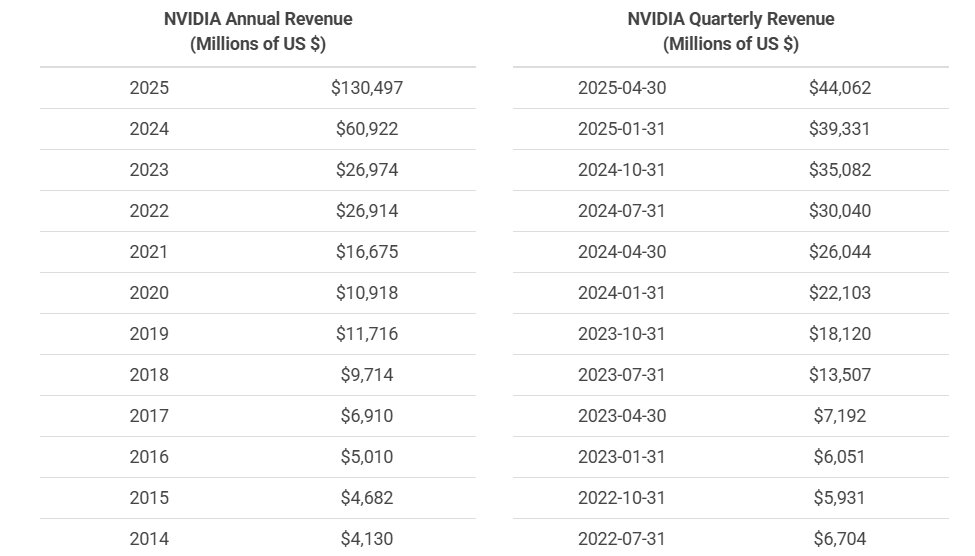
NVIDIA announces stellar Q2 FY2025 results. Revenue hits $30 billion. This achievement marks a 122% year-over-year (YoY) surge. The data centre segment continues to fuel growth. This segment contributes massively to total revenue. GPU sales soar high. The company expects $32.5 billion in Q3. Annual FY2025 revenue reaches $130.5 billion. That represents 114% growth from the prior year. AI demand propels these figures. NVIDIA dominates AI accelerators. It holds about 70% to 95% market share. Competitors trail behind.
Meanwhile, AMD posts record Q2 2025 revenue. Sales total $7.7 billion. Growth stands at 32% year-over-year. The data centres drove this spike. Server and PC processors continue to shine. Gross margin hits 40%. Net income reaches $872 million. Free cash flow exceeds $1 billion. The company forecasts $8.7 billion for Q3. AI chip sales continue to grow steadily. However, projections may disappoint. Analysts expect $10 billion in 2025. Some forecast only $7 billion.
NVIDIA and AMD Comparison
In comparison, NVIDIA AMD chip sales reveal stark contrasts. NVIDIA’s revenue dwarfs AMD’s. It is impossible to compare NVIDIA’s $30 billion revenue to AMD’s $7.7 billion in Q2, as there is more than a $22 billion difference between them.
Growth rates differ too. NVIDIA surges 122%. AMD climbs 32%. Yet, AMD gains ground in data centres. Its revenue there jumped 122% year-over-year in late 2024. That said, both companies are targeting AI markets aggressively.
Market share statistics highlight disparities. NVIDIA commands 92% of the GPU market in Q1 2025. AMD holds 8%. Intel gets zero. In AI chips, NVIDIA secures an average of 88%. AMD claims 4%. AMD’s share rises gradually. The competition intensifies in AI chips as AMD’s MI300 series competes directly with NVIDIA’s H100.
NVIDIA AMD Chip Sales Vulnerable to Geopolitics
Additionally, geopolitical factors affect NVIDIA AMD chip sales. Both companies have agreed to pay 15% of China revenues to the US government. This obligation applies to advanced AI chips. NVIDIA’s H20 falls under this agreement. Despite the back-and-forth trade disputes between Donald Trump and Xi Jinping, this agreement has gone a long way to ease trade curbs.
As a result, NVDA and AMD stocks have soared. China remains a key market due to their extensive use of new technological equipment in their daily activities. Sales from the Asian country boost revenue totals massively. Despite this, trade restrictions persist as the US and China both aim to be the go-to marketplace for AI-related tools.
Looking ahead, NVIDIA AMD chip sales promise excitement. NVIDIA launches Blackwell GPUs. They enhance AI performance. AMD unveils the MI400 series. It aims for parity. As AI demand explodes globally, data centres expand rapidly, and cloud providers invest heavily. Once this happens, both firms benefit immensely.
NVDA and AMD stock performance in 2025
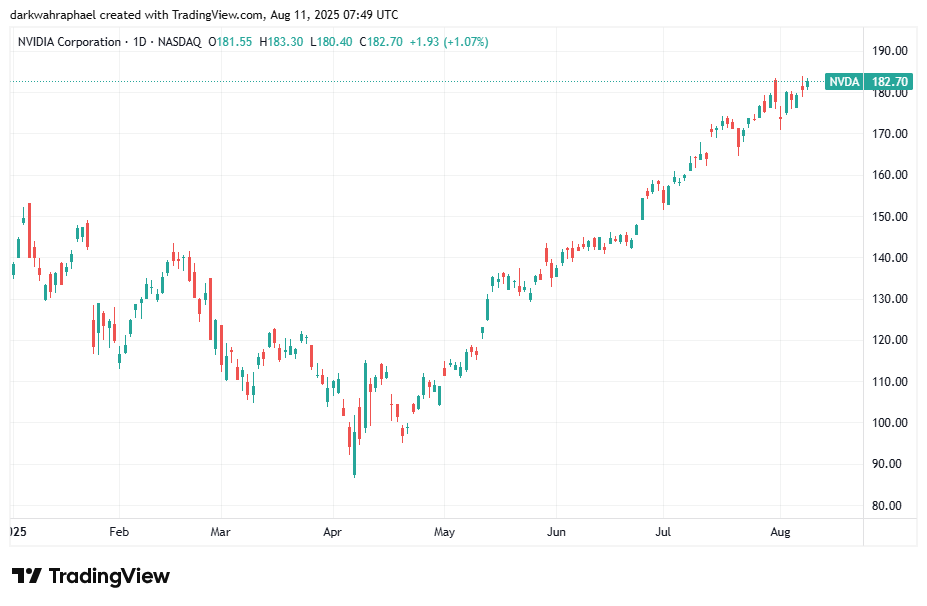
Moreover, stock performances reflect sales trends. NVIDIA’s shares have risen 35% in 2025 from $136 on January 2 to a new peak price of $184 in August.
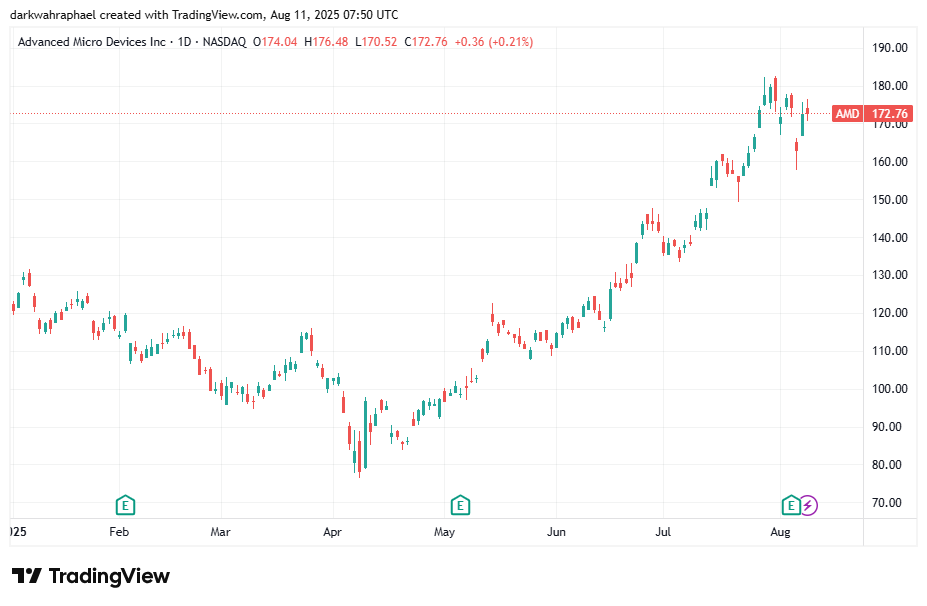
AMD’s stock has also performed massively on the market. AMD reached a peak of $182.50 on July 31 after opening the year at $122, a 49% spike in seven months.
In the short term, many analysts favour NVIDIA. That said, many believe AMD has positioned itself for gains by 2028. Whatever the case may be, some analysts think diversification favours AMD, as it has a broad range of products that span PCs and servers.
In essence, NVIDIA AMD chip sales shape the tech future. As NVIDIA leads decisively, AMD innovates persistently. investors should analyse data closely, as transitions in both centralised and decentralised financial markets occur quickly. As both companies adapt proactively, the AI revolution will continue unabated.
Stakeholders of the two stocks must monitor quarterly reports. As NVIDIA’s dominance endures, AMD’s growth accelerates. With more strategic partnerships from both companies, their respective ecosystems could expand across the globe. While challenges are always present, AI, video gaming, and Web3 provide opportunities plentifully, which makes these stocks attractive long-term investments.
Conclusion
NVIDIA AMD chip sales underscore innovation. The technologies power computing advancements as industries transform digitally. It remains to be seen when the NVDA and AMD stocks will attempt to reach the $200 milestone.