


Bitcoin miner revenue stands as a crucial metric that reveals the financial health of the cryptocurrency mining ecosystem.
Miners diligently safeguard the Bitcoin network by confirming transactions and appending blocks to the blockchain, reaping rewards for their efforts.
This revenue directly impacts individual miners and large organisations by influencing their operational decisions and investments.
Moreover, as Bitcoin evolves, tracking Bitcoin miner revenue offers insightful information about market dynamics, technological advancements, and economic pressures.
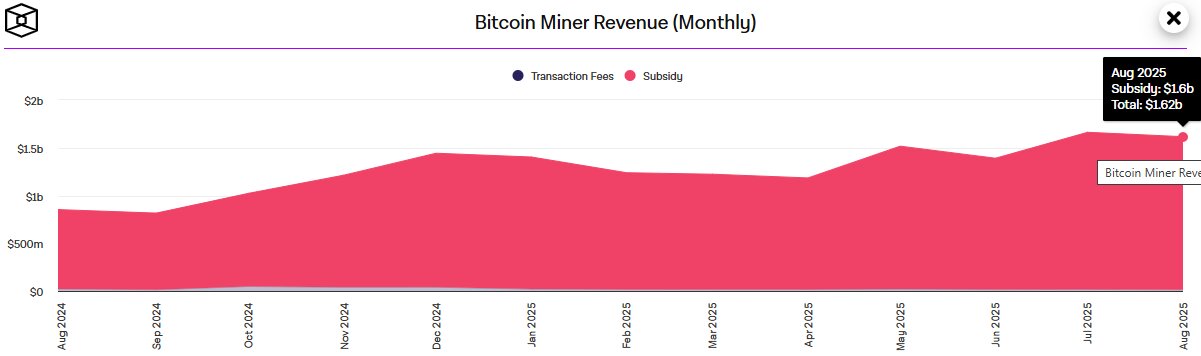
In August 2025, Bitcoin miner revenue reached an impressive $1.62 billion. This is an important turning point that shows the sector’s resilience and growth.
Understanding Bitcoin Miner Revenue
Bitcoin miner revenue encompasses the total income miners generate from their activities on the network. Miners receive this revenue primarily through block rewards. This sum encompasses newly minted Bitcoins and transaction fees paid by users to prioritise their transfers.
For example, when a miner effectively cracks a challenging computational problem, they secure the block reward along with all related transaction fees.
This process not only incentivises participation but also maintains the decentralised integrity of Bitcoin.
Additionally, Bitcoin miner revenue fluctuates daily, reflecting the network’s activity and overall market sentiment.
As a result, it serves as a barometer for the industry’s profitability, with higher revenue often attracting more miners and increasing competition.
How BTC Miner Revenue is Calculated
Experts calculate Bitcoin miner revenue by summing the value of block rewards and transaction fees over a specific period. This is typically done in USD for easy comparison.
The formula involves multiplying the number of blocks mined by the current block reward (which halves approximately every four years) and adding the aggregated fees.
For example, tools like mining calculators factor in hash rate, electricity costs, and Bitcoin’s price to estimate net revenue.
However, gross revenue focuses solely on inflows before deducting expenses such as energy and hardware.
Miners actively monitor these calculations to optimise their operations. This ensures they remain profitable amid changing conditions.
Consequently, accurate revenue tracking helps predict trends and guide strategic planning in the volatile crypto space.
Factors Influencing Miner Revenue
Several key factors actively shape Bitcoin miner revenue, creating a dynamic environment for participants.
Bitcoin’s price plays a pivotal role, as higher valuations amplify the USD worth of rewards and fees.
Additionally, network difficulty adjusts every two weeks, increasing competition and potentially reducing individual shares of revenue.
Transaction volume also boosts fees during peak usage, while halvings—events that cut block rewards in half—force miners to rely more on fees for sustainability.
Moreover, external elements like electricity costs, regulatory changes, and technological upgrades in mining hardware directly impact profitability.
For instance, efficient application-specific integrated circuit (ASIC) miners can lower operational expenses, enhancing net revenue.
As a result, miners must adapt swiftly to these influences to maintain steady income streams.
Historical Trends in Miner Revenue
Bitcoin miner revenue has exhibited remarkable trends over the years. It has evolved from modest beginnings to billion-dollar monthly figures.
Early on, in 2010, revenue was negligible due to low Bitcoin prices and minimal competition.
However, as adoption grew, revenue surged during bull markets, peaking at over $1 billion monthly in late 2021.
Post-halving periods often see temporary dips, followed by recoveries driven by price rallies.
For example, after the 2024 halving, revenue stabilised around $800–$900 million monthly before climbing.
Additionally, transaction fees have increasingly contributed, rising from under 1% to significant portions during congested periods.
Overall, historical data shows a compounding growth trajectory, with revenue multiplying tenfold from 2020 to 2025. This reflects Bitcoin’s maturation as an asset class.
August 2025: A Closer Look
In August 2025, Bitcoin miners’ revenue totalled $1.62 billion, securing its position as the second-highest monthly figure on record, just behind July 2025’s $1.66 billion.
This represented a slight 2% decline from the previous month, yet it showcased a staggering 90% increase compared to August 2024’s $851 million.
Miners actively capitalised on favourable conditions, demonstrating the sector’s robust recovery after halving.
Furthermore, this revenue surge highlights how miners have adapted to higher operational demands, maintaining profitability despite minor monthly fluctuations.
The Impact of Bitcoin Price and Trading Volume on Revenue
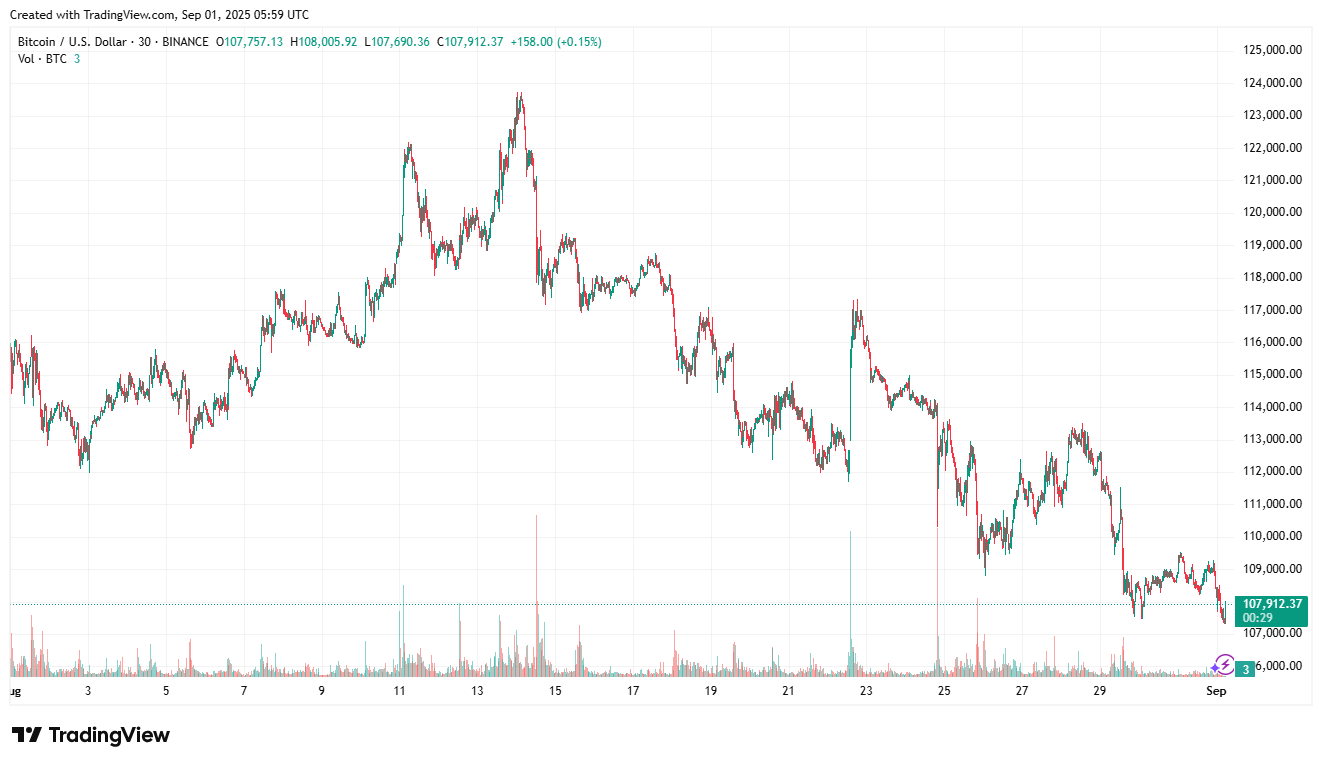
Bitcoin’s price range in August 2025, oscillating between $107,444 and $124,457, directly bolstered miner revenue by elevating the value of earned rewards.
Higher prices encourage more network activity, which in turn inflates transaction fees. Always remember that transactional fees are a critical revenue component.
On August 14, 2025, trading volume hit a monthly record of $104 billion, spiking fees and contributing to the elevated monthly total.
As a result, such volatility amplifies revenue and attracts institutional interest, further stabilising the ecosystem.
However, sharp price drops could reverse these gains, showing the need for miners to hedge against market swings.
Future Outlook
Looking ahead, Bitcoin miner revenue appears poised for continued growth, driven by technological innovations and expanding adoption.
Many experts predict that as Bitcoin integrates into mainstream finance, transaction volumes will rise, offsetting halving effects.
Additionally, advancements in energy-efficient mining and potential regulatory clarity could lower costs and boost net income.
However, challenges like geopolitical tensions affecting energy prices may introduce uncertainties.
Nevertheless, with Bitcoin’s price potentially climbing further, miners could see revenue exceeding $2 billion monthly by 2026.
Organisations are actively investing in scalable operations to capitalise on these trends and ensure long-term viability.
In conclusion, Bitcoin miner revenue remains a vital indicator of the cryptocurrency’s economic vitality.
From its calculation methods to influencing factors and recent highs in August 2025, this metric offers profound insights for investors and participants alike.
As the industry matures, monitoring these trends will prove essential for navigating the exciting world of Bitcoin mining.

