
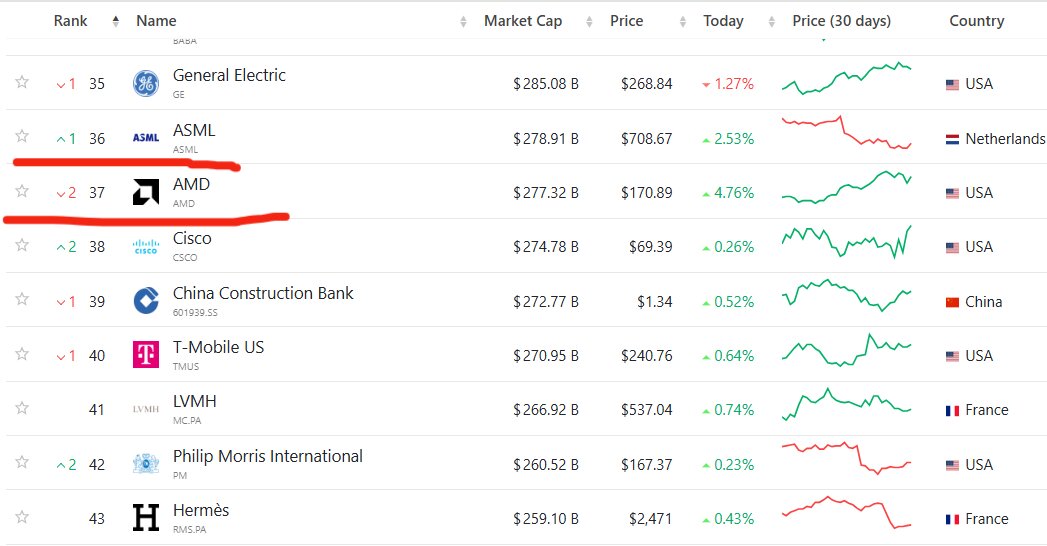
Advanced Micro Devices (AMD) dominates headlines with its $270 billion market capitalisation.
This semiconductor giant outshines Toyota, IBM, Morgan Stanley, McDonald’s, and Goldman Sachs in market value. This explains why investors are buzzing about its potential.
But is AMD a golden ticket to millions, or does it carry hidden risks?
This article dives into AMD’s world, exploring its strengths, weaknesses, and whether it’s a millionaire-maker stock.
Let’s unpack the pros and cons, how to invest, and what the future holds.
What is AMD?
Advanced Micro Devices, Inc. (AMD) designs high-performance semiconductors for computing, graphics, and artificial intelligence (AI) applications. Founded in 1969, AMD operates in Santa Clara, California.
The organisation concentrates on four core areas: data infrastructure, personal computing, interactive entertainment, and integrated systems.
Its Data Centre segment powers servers with central processing units (CPUs), graphic processing units (GPUs), and AI accelerators. Meanwhile, the Client segment delivers computing platforms for PCs. The Gaming segment drives graphics for consoles and PCs, while Embedded targets specialised processors.
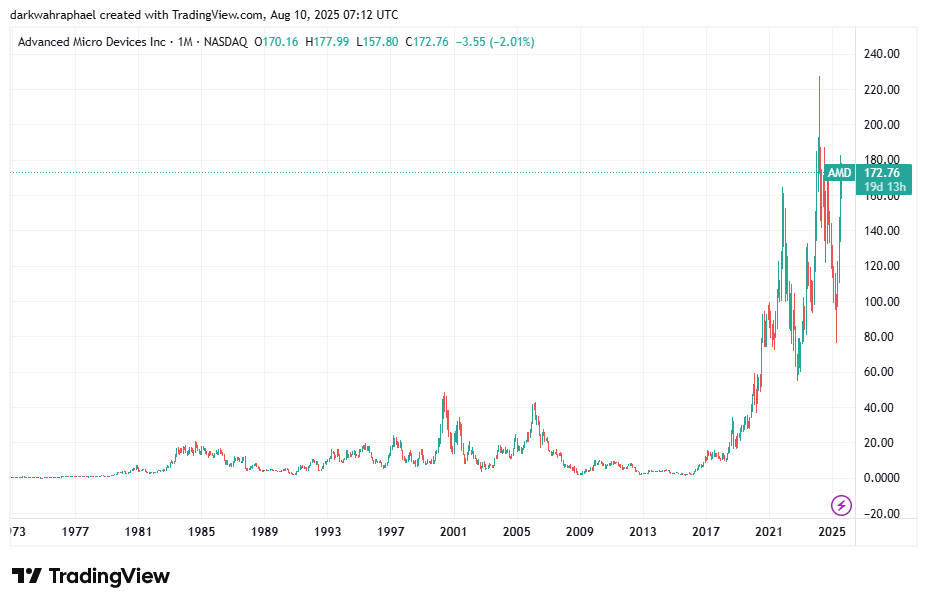
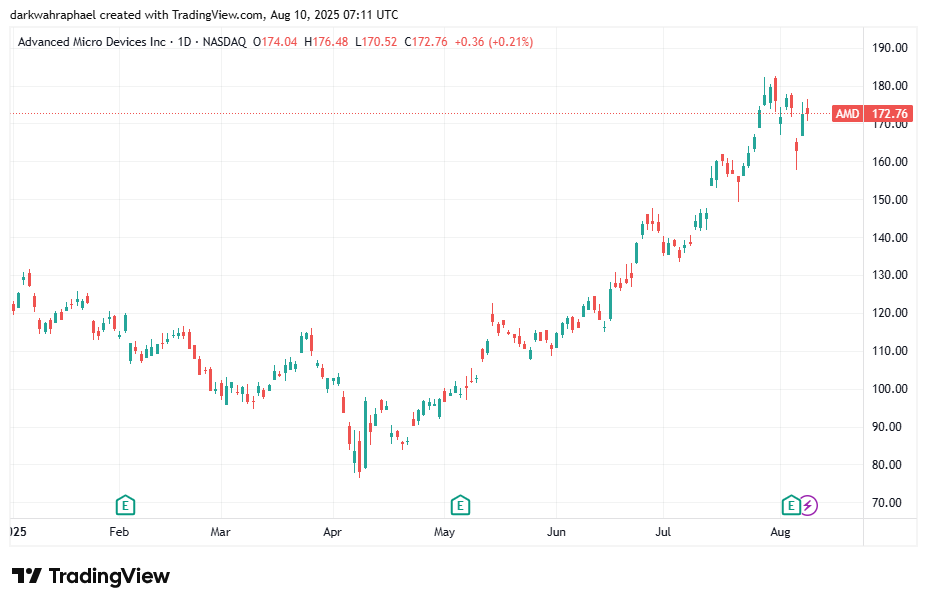
Under CEO Lisa Su’s leadership since 2014, AMD transformed from near bankruptcy to a tech powerhouse. Its stock reached a peak price of $182.50 in 2025 and has traded for a minimum price of $76.48 over the past 52 weeks.
AMD’s innovations, like EPYC processors and Radeon graphics, fuel its growth. Key acquisitions, like Xilinx in 2022, enhance its artificial intelligence and data infrastructure expertise.
Today, AMD competes fiercely with Nvidia and Intel, capitalising on the AI and high-performance computing boom.
The Pros of Investing in AMD
Explosive Revenue Growth
AMD’s financials dazzle investors. In Q2 2025, the company achieved $7.7 billion in revenue, reflecting a 32% growth compared to the previous year. The Data Infrastructure division skyrocketed to $3.2 billion in Q3 2024, fuelled by soaring AI demand.
This growth underscores AMD’s ability to seize high-demand markets. Its stock climbed 49% in 2025 from $122.29 on its opening day in January to $182.50 on July 31. The spike in stock price is a reflection of strong market confidence.
Strategic AI Investments
AMD aggressively pursues AI leadership. Its collaboration with HUMAIN, valued at $10 billion, advances global AI solutions. Additionally, the acquisition of Xilinx strengthens its position in programmable logic devices.
Analysts predict the AI accelerator market could grow 900% by 2027, reaching $400 billion. AMD’s focus on AI GPUs positions it to capture significant market share, rivalling Nvidia.
Analyst Optimism
Wall Street remains bullish. Thirty-five analysts give AMD a Moderate Buy rating, with 24 Buy and 10 Hold recommendations. The consensus price target stands at $156.47, with projections reaching as high as $210. Closing 2025 with an average price of $156 will still see AMD holders with 28% gains in their investment portfolios.
Firms like Mizuho projected a $180 target, which was surpassed in July. While Mizuho suggested a 40% upside, the stock has surpassed such expectations even with its current price of $172.76 as of the close of August 8. This optimism fuels investor enthusiasm for AMD’s growth trajectory.
Strong Leadership
CEO Lisa Su’s track record inspires confidence. She transformed AMD, elevating its market capitalisation from $2.07 billion in 2014 to an impressive $270 billion today.
Her strategic vision drives innovation in AI and computing. This is why AMD consistently outperforms expectations, positioning it as a leader in the semiconductor space.
Market Share Gains
AMD steadily erodes competitors’ dominance. Its x86 CPU market share grew from 18% in 2017 to 33% in 2024. Meanwhile, its AI GPU investments challenge Nvidia’s stronghold. This shift signals AMD’s potential to capture more of the $400 billion accelerator market by 2027.
The Cons of Investing in AMD
High Valuation Risks
AMD’s $270 billion market cap raises concerns. Its price-to-earnings ratio often exceeds industry averages, indicating overvaluation. In 2024, the stock fell 9% due to market volatility and high expectations. Investors fear a correction if growth slows.
Intense Competition
AMD faces fierce rivals like Nvidia and Intel. Despite massive gains from 17% to 33% over the past seven years, Nvidia dominates the AI GPU market, while Intel holds 63% of the x86 CPU market. This competition could erode AMD’s market share. Maintaining growth requires constant innovation and execution.
Market Volatility
The semiconductor industry is cyclical. Economic downturns or supply chain disruptions can hammer stock prices. Since July 31’s peak, AMD’s stock has experienced a 5% swing, showcasing its market volatility.
Investors must brace for unpredictable swings.
Margin Compression
Despite revenue growth, AMD’s profit margins face pressure. Q2 2025 earnings were slightly below expectations, causing stock dips. Rising costs in AI development and manufacturing could further squeeze margins, worrying investors.
Regulatory Risks
Export curbs pose challenges. In 2024, tightened restrictions hit AMD’s earnings, though relief is expected in 2025. Geopolitical tensions or new regulations could disrupt AMD’s global operations, impacting profitability.
How to Invest in AMD
Investing in AMD is straightforward. First and foremost, open an account with an online brokerage like Fidelity, Schwab, or Robinhood.
Next, research AMD’s stock (NASDAQ: AMD) using platforms like TradingView or Yahoo Finance. Monitor key metrics like revenue growth and earnings reports.
Consider dollar-cost averaging (DCA) to mitigate volatility. This strategy involves investing a fixed amount regularly, reducing risk. For instance, allocate $1,000 each month to purchasing AMD stock.
Alternatively, explore exchange-traded funds (ETFs) like Invesco QQQ, which include AMD. Always assess your risk tolerance before investing.
For active traders, use technical indicators like moving averages or RSI to time entries. AMD’s stock recently broke a triangle pattern, signalling potential upside to its peak of $182.48 before making a run towards the $200 milestone. Stay updated via AMD’s earnings calendar to know where to take your holdings.
Conclusion: So, Is AMD a Good Investment?
AMD’s strengths are undeniable. Its robust revenue expansion, emphasis on AI innovation, and visionary leadership under Lisa Su position it as an attractive investment option.
The company’s $270 billion market cap reflects its dominance, surpassing giants like Toyota and McDonald’s. Analyst optimism and market share gains further bolster its case. However, risks loom large. Elevated valuations, intense competition, and market fluctuations call for prudent decision-making.
Margin pressures and regulatory hurdles add uncertainty.
For long-term investors, AMD offers strong potential. Its AI investments align with a booming market. Yet, short-term traders face risks from price swings. Using dollar-cost averaging and staying informed can balance these risks. Ultimately, AMD’s growth trajectory makes it a solid pick, but patience is key.
Will AMD Be a Millionaire Maker Stock?
Could Advanced Micro Devices turn a modest investment into millions? Possibly. A $1,000 investment at $172 in August 2025 could yield $349.73 by December, per CoinCodex’s 34.97% ROI forecast.
Long-term predictions are bolder. By 2030, AMD’s stock could hit $1,000, driven by the $400 billion AI accelerator market. A $10,000 investment today at $172 could grow to $58,139 by 2030, assuming a $1,000 target.
However, millionaire status requires significant capital or extraordinary growth. For instance, reaching $1 million from $10,000 demands a 9,900% increase, or $17,232 per share.
Even with AMD’s projected 900% accelerator market growth, this seems unlikely by 2030. Still, AMD’s trajectory suggests substantial returns for disciplined investors. Diversifying and monitoring market trends will maximise chances of outsized gains.
In summary, AMD isn’t a guaranteed millionaire-maker. Its high valuation and risks temper expectations. Yet, its AI-driven growth and strong fundamentals make it a standout.
Investors willing to navigate volatility could see impressive returns, but millionaires need more than AMD alone. Stay strategic, and AMD could be a cornerstone of wealth-building.