

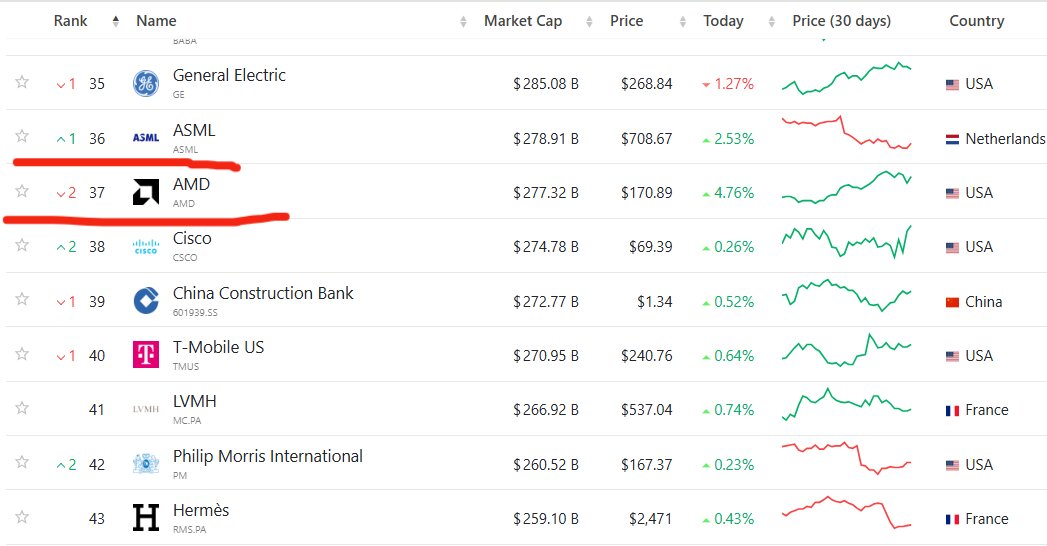
Advanced Micro Devices (AMD) has surged into the spotlight, climbing the ranks to become one of the top 50 companies globally in terms of market capitalisation.
As of publication, AMD had a valuation exceeding $270 billion. Thus, it now outpaces financial giant Morgan Stanley and automotive titan Toyota.
But what drives this semiconductor powerhouse’s meteoric rise, and is it a smart investment?
In this article, we dive deep into AMD’s journey, its market position, and the factors shaping its future. This will help you decide whether AMD stock deserves a place in your portfolio.
AMD at a Glance
AMD, headquartered in Santa Clara, California, stands as a leading force in the semiconductor industry. The company designs and manufactures microprocessors, graphics processing units (GPUs), and system-on-chip (SoC) solutions for diverse sectors.
This includes data centres, personal computers, gaming, and embedded systems.
Notably, AMD operates as a fabless company, meaning it designs its chips but outsources production to foundries like Taiwan Semiconductor (TSMC).
On August 7, 2025, AMD’s market cap soared to roughly $277 billion, cementing its rank as the 37th most valuable company globally.
With 28,000 employees and a robust product portfolio, AMD competes fiercely with industry giants like Intel and Nvidia.

Why Was AMD Formed?
Founded in 1969 by Jerry Sanders III, AMD emerged with a mission to challenge Intel’s dominance in the microprocessor market.
Initially, the company focused on producing affordable, high-performance chips for computers.
Over the decades, AMD has expanded its scope, venturing into GPUs, data centre solutions, and embedded systems.
Its acquisition of Xilinx in 2022 broadened its reach to field-programmable gate arrays (FPGAs), strengthening its foothold in automotive and datacenter applications.
Today, AMD’s strategic vision focusses on powering the artificial intelligence (AI) revolution. The company delivers cutting-edge chips for AI, cloud computing, and gaming consoles like the Sony PlayStation and Microsoft Xbox.
How Many AMD Shares Are in Supply?
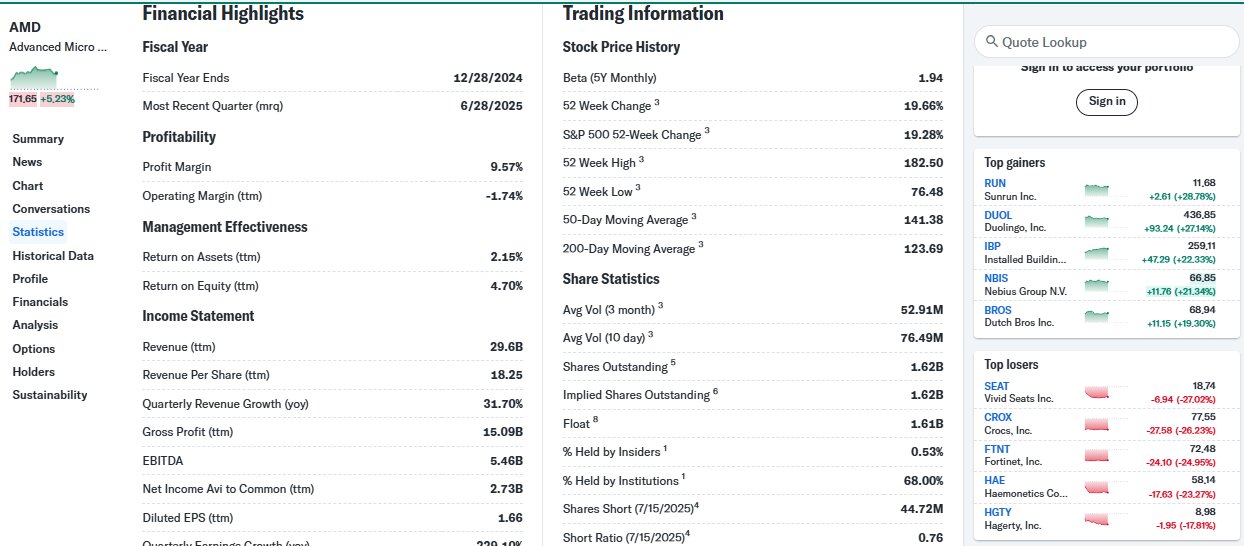
As of August 7, 2025, AMD has approximately 1.62 billion shares outstanding. This figure, combined with a stock price of around $171, contributes to its $277 billion market capitalisation.
The number of shares outstanding reflects AMD’s growth through stock issuances and buybacks, with the company announcing a $6 billion share repurchase program in May 2025.
This initiative signals confidence in long-term value creation, potentially boosting shareholder returns by reducing the share count over time.
AMD Partnerships
AMD’s strategic alliances amplify its market influence. For instance, its collaboration with Microsoft and Meta Platforms bolsters demand for its Instinct AI accelerators, positioning AMD as a viable alternative to Nvidia in the AI chip market.
Additionally, a $10 billion partnership with HUMAIN, announced in May 2025, aims to advance global AI infrastructure, reinforcing AMD’s role in the AI ecosystem.
Moreover, AMD’s EPYC processors power Nokia’s cloud infrastructure and Google Cloud’s virtual machines, showcasing their penetration into telecom and cloud computing.
These partnerships diversify revenue streams and enhance AMD’s competitive edge in high-growth sectors.
AMD Price Performance
AMD’s stock has delivered impressive gains, rising 49% in market capitalisation in 2025. The stock opened at $122.29 on January 2 and reached a year-high price of $182.50 on July 31.
In Q2 2025, the company reported record revenue of $7.7 billion, driven by a 57% surge in its data centre segment and a 68% increase in its client segment, fuelled by EPYC CPUs and Zen 5 chip adoption.
However, the stock experienced volatility after a mixed Q2 earnings report, with earnings slightly missing expectations despite beating revenue forecasts.
Despite this, AMD’s stock boasts a price-to-sales (P/S) ratio of 8.9, notably below Nvidia’s revenue, indicating potential for further valuation growth.
Pros of Buying AMD
Investing in AMD offers several compelling advantages. First and foremost, it’s Data Centre segment grew 122% year-over-year (YoY) in Q3 2024, outpacing Nvidia’s. This signals robust demand for its AI and server chips.
Secondly, AMD’s diversified portfolio spans Personal Computers (PCs), gaming, and embedded systems. This reduces the company’s reliance on a single market.
Thirdly, analysts project AMD’s revenue to hit $8.7 billion in Q3 2025. Many of the analysts believe that revenue will be driven by AI GPU and server CPU growth.
Furthermore, AMD’s competitive pricing and total cost of ownership (TCO) advantages make its chips attractive to major tech firms seeking alternatives to Nvidia.
All these are indicators of a potential price surge in AMD stock.
Cons of Buying AMD
Despite its strengths, AMD faces notable risks. Mainly, it lags behind Nvidia in the AI chip sector, posting $3.5 billion in data centre revenue for Q3 2024 versus Nvidia’s $30.8 billion.
Furthermore, Intel’s aggressive push to recapture dominance in the PC CPU market presents a significant challenge.
Concerns regarding margin growth and execution risks were also raised when AMD’s Q2 2025 earnings fell short of forecasts. Market volatility, particularly in the semiconductor sector, could also pressure AMD’s stock price.
Lastly, reliance on TSMC for manufacturing introduces supply chain risks, especially amid geopolitical tensions affecting chip production.
How to Invest in the Stock
Investing in AMD is straightforward. First and foremost, open an account with a reputable online brokerage, such as Fidelity, Charles Schwab, or Robinhood.
Next, fund your account and search for AMD’s ticker symbol (NASDAQ: AMD).
Then, decide on the number of shares to purchase based on your budget and risk tolerance.
Alternatively, consider investing in exchange-traded funds (ETFs) like the Invesco QQQ Trust (QQQ), which includes AMD, for broader semiconductor exposure.
Finally, monitor your investment regularly, staying informed about AMD’s earnings reports and industry trends through platforms like Yahoo Finance or TradingView.

Price Predictions: What Are Analysts and Experts Advising?
Analysts remain bullish on AMD’s prospects. In August 2025, Northland Securities raised its price target to $198, citing AMD’s potential to gain market share in AI GPUs and server CPUs.
Likewise, Benchmark raised its price target to $210, and Barclays established a $200 target, signalling confidence in AMD’s growth within the AI and PC markets.
However, TD Cowen improved its price target from $165 to $195, citing CPU and gaming segments. Northland ranked AMD as a top pick for 2025, projecting AI revenue to reach $9.5 billion, up from $5.2 billion in 2024.
The Bottom Line – Should You Buy Advanced Micro Device?
AMD’s ascent to a top 50 company underscores its growing influence in the semiconductor space. Its strong performance in AI, data centres, and PCs, coupled with strategic partnerships, positions it for sustained growth.
However, competition from Nvidia and Intel, along with execution risks, warrants caution.
For long-term investors, AMD’s attractive valuation and AI-driven growth make it a compelling buy, provided they can tolerate short-term volatility.
Thus, if you’re seeking exposure to the AI and semiconductor boom, AMD could be a solid addition to a diversified portfolio.
Can You Mine AMD?
No, you cannot mine AMD. Unlike cryptocurrencies like Bitcoin, AMD is a publicly traded company, not a digital asset.
Instead, investors can purchase AMD stock or options through a brokerage. The term ‘mining’ applies to blockchain-based assets, not corporate equities.
However, AMD’s chips, particularly its GPUs, are popular for cryptocurrency mining, indirectly linking the company to this space.
Will the Stock Go Up?
Predicting stock price movements is inherently uncertain, but AMD’s outlook appears promising. Analysts forecast 27% revenue growth in 2025, driven by AI and server chip demand.
Moreover, its partnerships with tech giants and competitive chip pricing bolster its growth potential.
Nonetheless, macroeconomic factors, such as interest rate hikes or supply chain disruptions, could impact its trajectory.
Technical indicators, like a weekly RSI of 80.4, suggest strong momentum but also potential overbought conditions. This hints at possible short-term pullbacks before further gains.
Is AMD a Good Investment?
AMD presents a strong case for investors. Its leadership in AI chips, robust revenue growth, and strategic acquisitions like Xilinx position it for long-term success.
Furthermore, its valuation is more compelling than Nvidia’s, presenting potential for significant growth.
However, risks like intense competition and market volatility require careful consideration. For risk-tolerant investors with a long-term horizon, AMD’s diversified portfolio and AI exposure make it a worthwhile investment.
Conversely, conservative investors may prefer waiting for a dip to mitigate downside risks.
Ultimately, AMD’s growth trajectory and market position make it a stock to watch in 2025.


AMD’s stock has had ups and downs. Not convinced this is the right time to jump in. Too much competition from Nvidia and Intel. AMD’s gotta do more to stand out.
AMD’s been a strong player in CPUs and GPUs. Holding for the long haul looks good to me. With AI and gaming driving demand for chips, AMD’s positioned decently for the future.
AMD is doing well in some areas, but competition in the chip market is fierce. Need to watch their margins. Before buying AMD, I’d want to see more on their growth strategy beyond current product lines.
AMD’s gaining ground on Intel. Now is a great time to buy before they take off. With their new chips performing so well, AMD’s stock looks like a solid buy.