In the fast-paced world of retail giants, Walmart Inc. (WMT) recently faced an unexpected challenge with the “Radioactive Shrimp WalMart” incident.
However, investors quickly dismissed the potential fallout, allowing the stock to maintain its upward trajectory.
This article describes how WMT demonstrated remarkable resilience amid adversity, showcasing the company’s robust market position.
Furthermore, it highlights key factors that shielded the stock from volatility, offering perspective for savvy investors.
Overview of the Radioactive Shrimp WalMart Incident
The Food and Drug Administration (FDA) actively investigated reports of Cesium-137 contamination in frozen raw shrimp from an Indonesian supplier, PT. Bahari Makmur Sejati, intended for Walmart’s Great Value label.
Authorities detected the radioactive isotope in shipping containers at major U.S. ports. This included Los Angeles and Houston, prompting a precautionary recall of specific lots on August 19, 2025.
Walmart swiftly pulled the affected products from shelves in 13 states, advising consumers to discard or return them for refunds.
Although the contamination levels fell below the FDA’s threshold for immediate health risks—measuring around 68 becquerels per kilogram against a limit of 1,200—public concern surged.
Media outlets amplified the story, with headlines warning of “radioactive shrimp” potentially entering the food supply.
Nevertheless, Walmart assured stakeholders that no tainted shrimp reached consumers. The retailers emphasised their rigorous supply chain protocols.
This event could have rattled investor confidence in a lesser company. Instead, WMT’s stock price exhibited steadfast stability. This demonstrates the retail giant’s resilience in the face of challenges.

WMT Stock Performance: A Display of Unwavering Strength
When the recall news surfaced on August 19, 2025, Walmart’s stock surged confidently. WMT ended the day at $101.36, a 0.66% increase from the prior close of $100.70.
Traders pushed the price to a high of $102.43 during the session, with trading volume reaching approximately 17 million. This aligned with average levels, indicating no panic selling.
As of early August 20, 2025, preliminary indicators showed the stock holding steady around $101.30 in after-hours trading. Statistics show no significant dips attributed to the incident.
Over the past week, WMT gained 3% month-to-date after opening the month at $98 and trading around $101. With this, it has outperformed broader market indices amid economic uncertainties like potential tariffs.
Moreover, examining longer-term trends reveals WMT’s resilience. The stock has surged 37% over the past 12 months, from $73.75 on August 20, 2024, to $101.29 on August 20, 2025. With this, it has outpaced the S&P 500’s 16.1% rise.
This performance persists despite external pressures, including inflation and supply chain disruptions.
Experts continue to endorse a “Strong Buy” recommendation. Many have projected a 12-month price goal of $108.67. This indicates a potential gain exceeding 7% from its present value.
Consequently, the Radioactive Shrimp WalMart episode failed to derail this momentum, as markets focused on Walmart’s core strengths.

Key Factors Fuelling Stock Resilience
Walmart’s massive scale actively buffers it against isolated incidents. With a market capitalisation exceeding $808 billion, the company diversifies across groceries, e-commerce, and international operations. This renders a single product recall negligible.
Additionally, Walmart’s proactive response, which included collaborating with the FDA and removing products immediately, mitigated reputational damage.
Experts note that the limited scope of the recall, affecting only three lots with a best-by date of March 15, 2027, further contained risks.
Furthermore, strong fundamentals underpin this stability. Walmart’s EBITDA stands at $42.86 billion. This reflects efficient operations and a 6.21% margin.
The company employs over 2.1 million people globally, leveraging economies of scale to absorb shocks.
Investors also value Walmart’s defensive positioning in a tariff-heavy environment, where its low-price model attracts budget-conscious consumers.
As one X (formerly Twitter) user observed, “Walmart had radioactive shrimp, and their stock price still didn’t dip,” highlighting market indifference.
Investor Sentiment and Broader Market Implications
Social media and financial forums buzzed with initial alarm over the Radioactive Shrimp WalMart news, yet sentiment swiftly shifted to optimism.
Posts on X emphasised Walmart’s quick action, with many joking about “glow in the dark” products while affirming trust in the brand.
Analysts echo this, pointing to upcoming Q2 earnings on August 21, 2025, where operating income is projected at $8.7 billion—a 10% year-over-year (YoY) increase.
However, the looming tariff increases pose a greater challenge, potentially acting as a “regressive tax” on budget-conscious consumers; nevertheless, Walmart’s flexibility—through enhanced discounts and strong e-commerce strategies—effectively mitigates this risk.
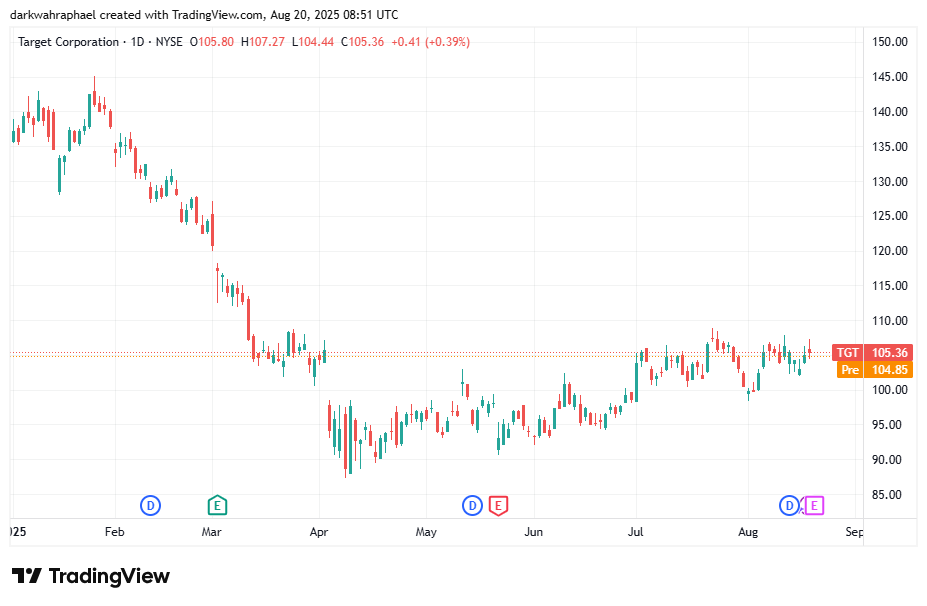
In comparison, rivals like Target (TGT) have faltered. Shares have slipped due to digital woes and higher import exposure.
As of publication, TGT has plunged 22% year-to-date (YTD) after opening the year at $135.75 on January 2 and exchanging hands for $105.36.
Walmart, conversely, thrives by dominating same-day grocery delivery and employee perks. The retailer covers 95% of store items with discounts.
This tactical advantage cultivates investor trust and bolsters WMT’s market stability.
Future Outlook: Sustained Growth amid Radioactive Shrimp WalMart Challenges
Looking ahead, WMT appears poised for continued resilience. With a beta of 0.74—indicating lower volatility than the market—investors view it as a safe haven.
Upcoming earnings could propel shares toward the 52-week high of $167.40, especially if results exceed expectations.
Nevertheless, monitoring supply chain risks remains crucial, as global events could introduce new variables.
In conclusion, the Radioactive Shrimp WalMart incident exemplifies how a well-managed crisis bolsters rather than breaks a titan like Walmart.
Investors actively reward such fortitude, ensuring WMT’s stock emerges unscathed and stronger.
This incident delivers a crucial insight: amidst challenges, genuine industry frontrunners radiate unmatched resilience.