

The Total Value Locked (TVL) stands as a pivotal gauge in the decentralised finance (DeFi) landscape. It measures the vitality and liquidity of blockchain-driven protocols.
Investors and analysts closely track total value locked to gauge user confidence and platform adoption.
As DeFi continues to evolve, total value locked reflects the total assets users commit to smart contracts. This drives innovation and economic activity.
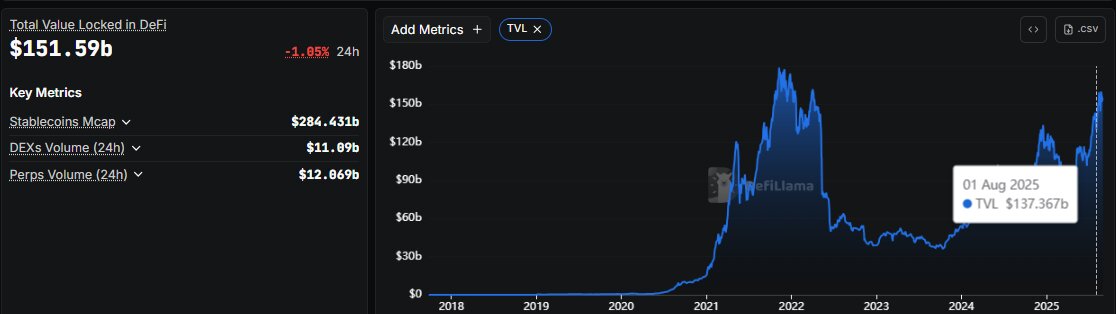
In August 2025, DeFi’s TVL climbed from $137 billion to $152 billion, marking a 10% increase and adding approximately $15 billion in locked value over 30 days.
This surge shows the sector’s resilience amid market fluctuations.
What Is Total Value Locked (TVL)?
Total Value Locked represents the aggregate dollar value of cryptocurrencies and digital assets that users deposit into DeFi protocols through smart contracts.
These assets include staked tokens, loaned funds, or liquidity provided for trading pools.
For instance, when users lock Ethereum (ETH) on a lending platform, they contribute to the protocol’s total locked value.
Moreover, this metric extends beyond simple deposits; it encompasses various use cases, like yield farming, staking, and decentralised exchanges (DEXs).
As a result, TVL provides a snapshot of a protocol’s or ecosystem’s economic scale, helping stakeholders identify thriving projects.
How Is TVL Calculated?
Analysts calculate the total locked value by summing the market value of all locked assets within a protocol or across an entire blockchain network.
The process begins with identifying the quantity of each asset staked or deposited. Then, experts multiply these quantities by their current market prices in USD.
For example, if a protocol holds 1 million ETH at $3,000 per token, that contributes $3 billion to the Total Value Locked (TVL).
Additionally, aggregators like DefiLlama or CoinGecko automate this by pulling real-time data from blockchains.
But changes in the price of cryptocurrencies can cause TVL to change quickly. This makes it a dynamic indicator rather than a static figure.
The Importance of Total Value Locked in DeFi
Total Value Locked serves as a critical indicator of the decentralised finance (DeFi) ecosystem’s growth and appeal to investors.
Higher TVL signals strong liquidity, which reduces slippage in trades and enhances protocol efficiency.
Moreover, it indicates user trust, as people willingly lock funds expecting returns through interest, rewards, or governance rights.
For instance, protocols with soaring TVL often attract more developers and partnerships, fostering innovation.
Conversely, a declining TVL might warn of security issues or market shifts.
As a result, investors use this metric to compare protocols and predict trends, guiding allocation decisions in a volatile space.
August 2025 Trends in DeFi TVL
In August 2025, the DeFi sector’s TVL demonstrated impressive growth, rising 10% from $137 billion on August 1 to $152 billion by month-end.
This expansion added roughly $15 billion in locked value over 30 days, highlighting sustained investor interest amid broader crypto recovery.
Additionally, this uptick reflects a broader adoption of DeFi tools, as users sought higher yields in a stabilising market.
However, growth varied across protocols, with some outperforming others due to unique features like liquid staking or yield optimisation.
Top-Performing Protocols Boosting TVL
Several decentralised applications drove the August surge in TVL. AAVE, a leading lending protocol, increased its total locked value by 22%, capitalising on improved borrowing rates and expanded asset support.
Lido experienced a 23% surge, taking the lead in Ethereum’s liquid staking arena, enabling users to earn rewards without permanently tying up their assets.
Ethena skyrocketed 42%, driven by its groundbreaking synthetic dollar stablecoin, drawing in cautious liquidity providers.
Pendle surged an impressive 60%, transforming yield trading by letting users tokenise and exchange future returns.
Jupiter, a Solana-based DEX aggregator, rounded out the leaders with a 30% rise, benefiting from faster transactions and lower fees.
Collectively, these protocols exemplify how innovation propels total value locked higher.
Factors Influencing TVL Growth
Various factors dynamically drive shifts in TVL. Market sentiment, tied to Bitcoin and Ethereum prices, often correlates with inflows.
Additionally, protocol upgrades, such as Ethereum’s scaling solutions, reduce gas fees and encourage more locking.
Regulatory developments also play a role; clearer guidelines can boost confidence.
However, risks like smart contract vulnerabilities might deter users, causing outflows.
As a result, monitoring these factors helps predict total value locked trajectories.

Future Outlook for Total Value Locked
Looking ahead, TVL in DeFi appears poised for further expansion in 2025 and beyond.
Analysts’ project continued growth, driven by real-world asset tokenisation and AI-integrated protocols.
Moreover, cross-chain bridges will likely increase interoperability, attracting more capital.
Gains could be curbed, though, by obstacles like market volatility and competition from traditional finance (TradFi).
Nevertheless, with August’s momentum, TVL may surpass $200 billion by year-end, solidifying DeFi’s mainstream appeal.
In summary, TVL empowers users to evaluate DeFi’s vibrancy and potential. From its calculation to August 2025’s notable gains in protocols like Pendle and Ethena, this metric guides informed decisions.
As decentralised finance evolves, monitoring total value locking is crucial for understanding this ever-changing ecosystem.