
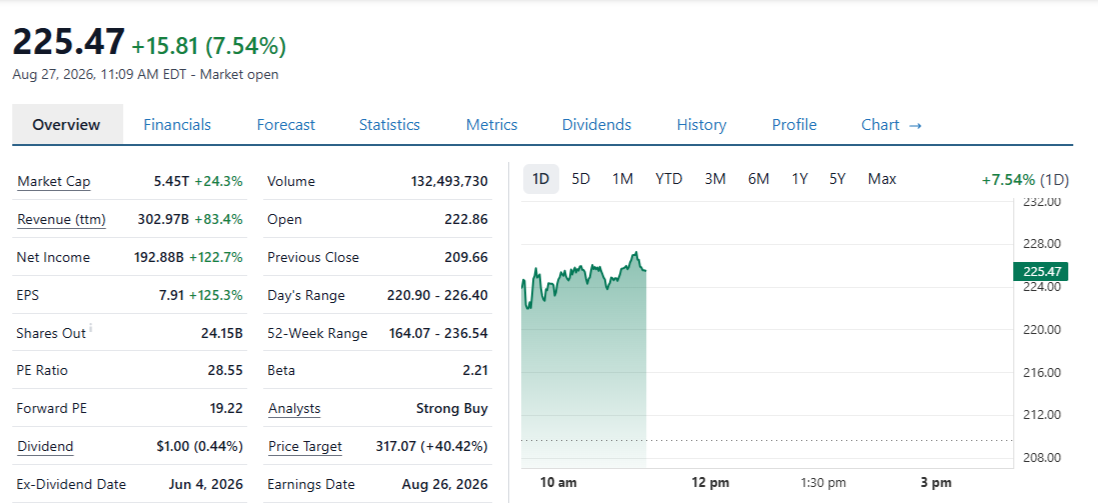
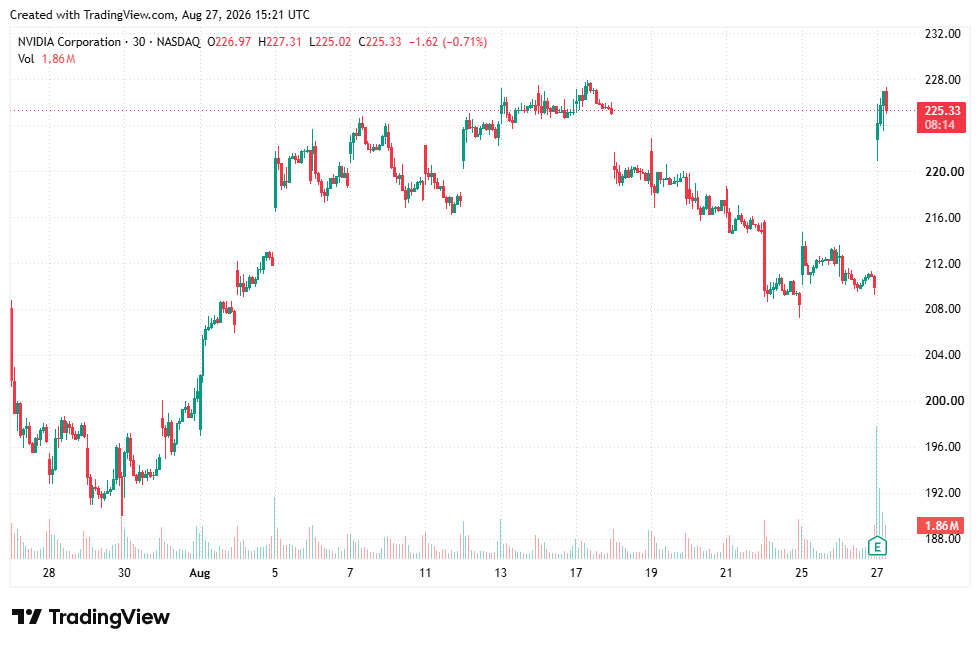
NVIDIA Stock Price (NVDA) has captured intense attention across markets on August 27, 2026. Investors watched shares climb roughly 6 to 8 percent after the company released its second-quarter fiscal 2027 results the prior evening.
The move added hundreds of billions in market value and lifted the broader chip sector.
People searching for NVIDIA Stock Price right now want clear answers about the drivers, the outlook, and the risks.
This article walks through the key questions with fresh detail drawn from company reports and analyst updates.
Why is NVIDIA stock rising/soaring today (or after earnings)?
NVIDIA Stock Price jumped because the company delivered numbers that exceeded expectations and, more importantly, offered a longer-term view that calmed lingering doubts about the durability of artificial intelligence (AI) demand.
Revenue reached $96.2 billion, up 106 percent from the year-earlier period. Data Centre revenue alone hit $89.0 billion, climbing 117 percent year over year.
Non-GAAP diluted earnings per share came in at $2.22. Gross margins held at 75.0 percent on both GAAP and non-GAAP bases.
Beyond the headline beat, the company guided third-quarter revenue to $108.0 billion, plus or minus 2 percent.
Management also shared a rare multi-year outlook, projecting roughly 70 percent revenue growth for fiscal 2028.
That figure sits well above prior Wall Street estimates near 45 percent. CEO Jensen Huang described AI as having reached an inflection point, with demand spreading from a handful of hyperscalers to a wider set of AI labs, neo-cloud providers, industrial users, and enterprises.
In particular, AI Clouds, Industrial, and Enterprise customers generated $40.3 billion in the quarter, up 138 percent year over year.
Meanwhile, supply and capacity commitments rose to $279 billion, signalling that the company continues to lock in future production.
The stock had lagged some peers earlier in 2026 amid worries over spending slowdowns and custom-chip efforts by customers.
The combination of another record quarter and explicit longer-term growth guidance reversed that caution in a single session.
At the same time, related names such as CoreWeave and Nebius also advanced, showing the broader AI infrastructure complex moved higher together.
What is the analyst price target / stock forecast for NVDA?
Following the report, multiple firms raised their targets for NVIDIA Stock Price. Consensus 12-month targets from roughly 60 analysts now average around $316, implying more than 40 percent upside from levels near $225.
That said, individual targets range widely. Some firms sit near $275 to $300, while others have moved higher, with notable raises to $346, $390, $420, and even $515 in the most optimistic cases.
In particular, Melius Research lifted its target to $420 and reiterated a Buy rating, citing expectations that NVIDIA can capture more than half of a multi-trillion-dollar AI market over time.
Truist Financial moved its target to $346 from $307. Rosenblatt raised its target to $390. Several other houses, including JPMorgan, Needham, and Goldman Sachs, also adjusted numbers upward, even when ratings stayed more measured.
The average rating remains Strong Buy, with the large majority of covering analysts recommending the shares.
These updates arrived quickly after the results, reflecting both confidence in the 70 percent fiscal 2028 growth signal and the continued ramp of platforms such as Blackwell Ultra and the emerging Vera Rubin generation.
Investors tracking NVIDIA Stock Price can watch how these targets evolve as more detailed models incorporate the new guidance.
Is NVDA stock a buy right now / should I buy after earnings?
Many market participants view the current setup as supportive for those with a multi-year horizon.
The Strong Buy consensus from the bulk of Wall Street analysts provides one data point.
Growth remains exceptional: revenue more than doubled year over year (YoY), and management indicated demand still exceeds supply.
Valuation metrics have moderated relative to history. Forward price-to-earnings ratios in the low-to-mid 20s appear in several analyses, a level some consider reasonable given the projected growth rate.
In addition, the company continues returning capital, with a quarterly dividend of $0.25 per share and remaining authorisation under its share-repurchase program.
Free cash flow generation stays robust. Still, every investor must weigh personal risk tolerance, time horizon, and portfolio construction.
Past performance does not guarantee future results, and the stock’s high market capitalisation means absolute gains or losses can be large even on modest percentage moves.
Readers should examine the full financial statements, the detailed outlook, and independent research before making decisions.
Will the AI boom / demand for NVDA chips continue (or is it peaking)?
Management’s 70 percent fiscal 2028 growth projection directly addresses this question.
The company presented the figure as a floor rather than a ceiling and noted that supply constraints currently limit even higher growth.
Huang pointed to a broadening customer base: multiple AI labs building large clusters simultaneously, rising capacity among specialised cloud providers, and expanding enterprise and industrial adoption.
Data Center revenue already accounts for the overwhelming majority of sales, and the sequential increase of 18 percent in the latest quarter shows momentum has not stalled.
Moreover, hyperscaler capital expenditure plans remain elevated, and NVIDIA continues securing multi-year supply agreements.
The ramp of next-generation architectures is expected to support both training and inference workloads.
While no cycle lasts forever, the current evidence from the company’s own backlog, customer commitments, and guidance points to sustained demand through at least the next couple of years.
Investors watching NVIDIA Stock Price will focus on sequential updates to order visibility and any shifts in hyperscaler spending patterns.
What are the main risks to NVDA’s stock price (competition, margins, supply, valuation)?
Several factors could pressure NVIDIA Stock Price even after a strong report. Competition from custom silicon designed by large customers, including efforts at firms such as OpenAI, remains a frequent discussion point.
Management has noted that many of these chips serve narrower use cases and that customers still rely on NVIDIA for scale, yet the trend warrants monitoring.
Supply constraints in advanced packaging and high-bandwidth memory continue to limit how quickly the company can meet demand; the $279 billion in commitments helps, yet bottlenecks persist.
Gross margins guided slightly lower to 74.0 percent, plus or minus 50 basis points, for the current quarter, reflecting higher memory costs.
The outlook also assumes no Data Center compute revenue from China, removing one potential growth source.
Valuation remains elevated in absolute terms given the company’s status as the world’s most valuable public firm, so any disappointment on growth or margins could trigger sharper reactions than for smaller peers.
Insider selling and circular financing concerns related to investments in customers have also drawn commentary.
Despite these risks, the latest results and guidance have shifted near-term sentiment in a constructive direction.
Readers following NVIDIA Stock Price should continue tracking quarterly updates on product ramps, customer diversification, and competitive developments for the clearest picture of sustainability.
In summary, the recent surge in NVDA Stock Price stems from concrete evidence that AI infrastructure spending retains strength and that the company remains positioned to capture a large share of that spending.
The combination of record results, raised near-term guidance, and an ambitious multi-year outlook has driven the move.
Balanced analysis of the opportunities and the risks outlined above can help investors form their own views as new information arrives.